Āhua Gallery
Select Subcategory
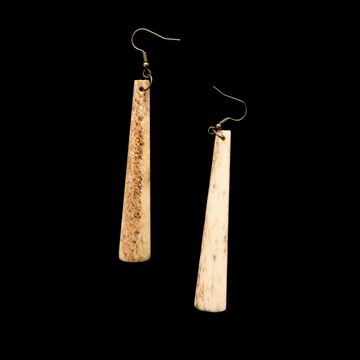
Toki Earrings - 5700RH
Toki earrings (or drop earrings) are designed to suspend from the bottom of the earlobes. The length varies from a centimetre or two, all the way to brushing the wearer's shoulders.
Material: Parāoa (Whalebone)
Measurements: 75mm x 15mm x 3mm
$490.00
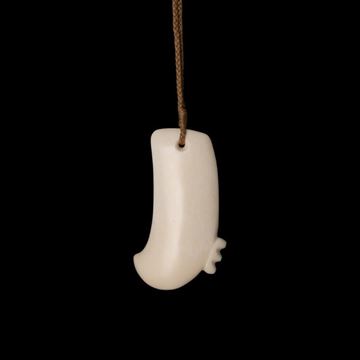
Rei Niho - 3789IA
The mark of a high Chief was one who wore the hei niho (whale tooth pendant), as the teeth of the sperm whale were highly prized because of their rarity. Usually these pendants had simply etched out eyes to form a head at one end. With actual whale teeth being such a rarity, it became common to fashion the tooth form from other materials.
Material: Koiwi (Beef Bone)
Measurements: 67mm x 40mm
$250.00
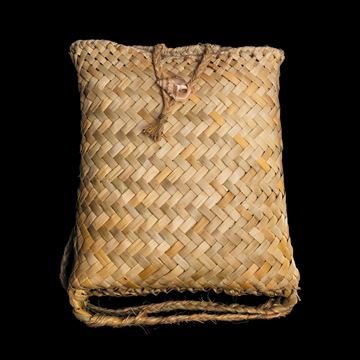
Kete Pikau - 8123MU
Kete Pikau (backpack) are used for carrying personal items.
Material: Harakeke (NZ Flax), Muka (NZ Fiber) & Pāua (Abalone Shell)
Measurements: 320mm x 360mm
$380.00
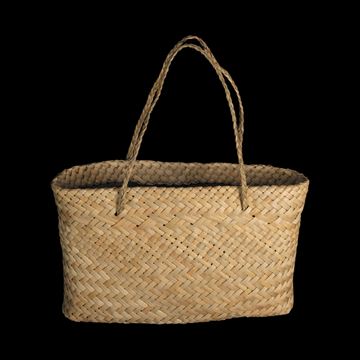
Kete Whakairo - 5827RW
Kete whakairo are woven flax bags of a finer quality than the general utilitarian kete. They are normally made from prepared strips of flax and/or kiekie, some of which have been dyed. Kete whakairo may also feature geometric designs.
Material: Harakeke
Measurements: 300mm x 190mm
$590.00
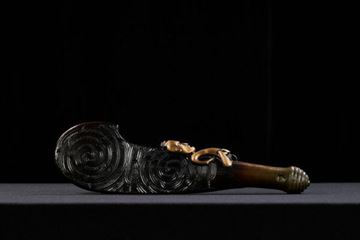
Wahaika - Black w Bronze (ed. 1/6) - 2487FD
The literal meaning of wahaika is: ‘waha’ (mouth); and, ‘ika’ (fish). It was specifically named because of the gap on the side of the weapon. Wahaika were used in close hand-to-hand combat to defect blows, and to strike the chest, head and wrist. Many wahaika have a small figure carved on their side called a pūkaiora which represented a tribal war God that would guard over the warrior during battle. The whiti or small head at the end of the handle was also a form of guardian. Wahaika are usually made from native hardwoods or whalebone.
$7,500.00
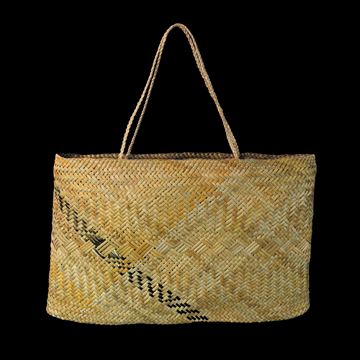
Kete Whakairo - 5907AY
Kete whakairo are woven flax bags of a finer quality than the general utilitarian kete. They are normally made from prepared strips of flax and/or kiekie, some of which have been dyed. Kete whakairo may also feature geometric designs.
Material: Harakeke, Muka & Gold Foil
Measurements: 420mm x 250mm x 60mm
$750.00
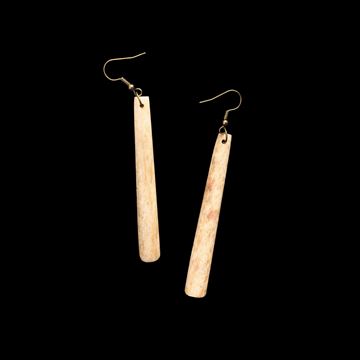
Toki Earrings - 6826RH
Toki earrings (or drop earrings) are designed to suspend from the bottom of the earlobes. The length varies from a centimetre or two, all the way to brushing the wearer's shoulders.
Material: Parāoa (Whalebone)
Measurements: 70mm x 9mm x 5mm
$490.00
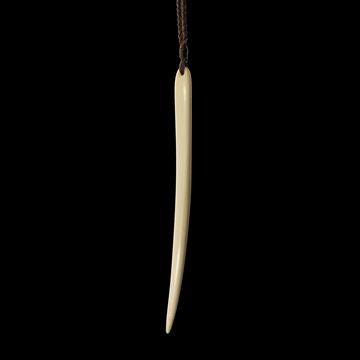
Autui - 6142HF
Autui were customarily used as a pin for fastening cloaks and may be made from bone, stone, wood or shell. They may also have been worn through the ear as an earring or around the neck as a pendant. Autui are still commonly worn as pendants and earrings and as with most Māori personal adornments, are often passed down generationally.
Material: Koiwi (Beef Bone)
Measurements: 125mm x 10mm x 4mm
$320.00
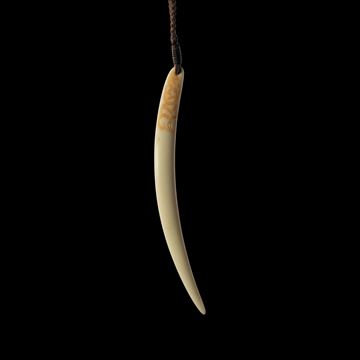
Autui - 6144HF
Autui were customarily used as a pin for fastening cloaks and may be made from bone, stone, wood or shell. They may also have been worn through the ear as an earring or around the neck as a pendant. Autui are still commonly worn as pendants and earrings and as with most Māori personal adornments, are often passed down generationally.
Material: Koiwi (Beef Bone)
Measurements: 106mm x 9mm
$390.00
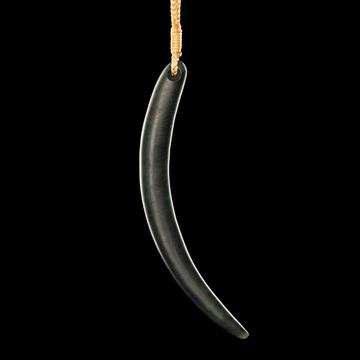
Autui - 7209LT
Autui were customarily used as a pin for fastening cloaks and may be made from bone, stone, wood or shell. They may also have been worn through the ear as an earring or around the neck as a pendant. Autui are still commonly worn as pendants and earrings and as with most Māori personal adornments, are often passed down generationally.
Material: Kawakwa (Pounamu)
Measurements: 106mm x 10mm
$435.00
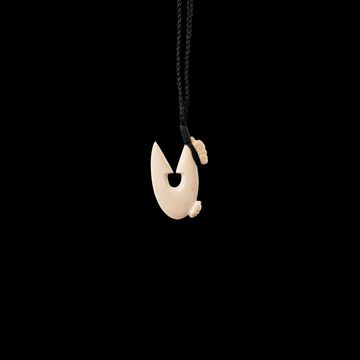
Hei Matau - 7224LT
Coastal and river-based Māori tribes traditionally used a variety of fishhooks and lures. Hooks and lures varied in shape, material and design. Today hei matau (fishhooks) have become symbolic of traditional Māori technology and continue to symbolize a relationship to Tangaroa, God of the sea.
Material: Wheua (Cattlebone)
Measurements: 28mm x 40mm
$339.00