
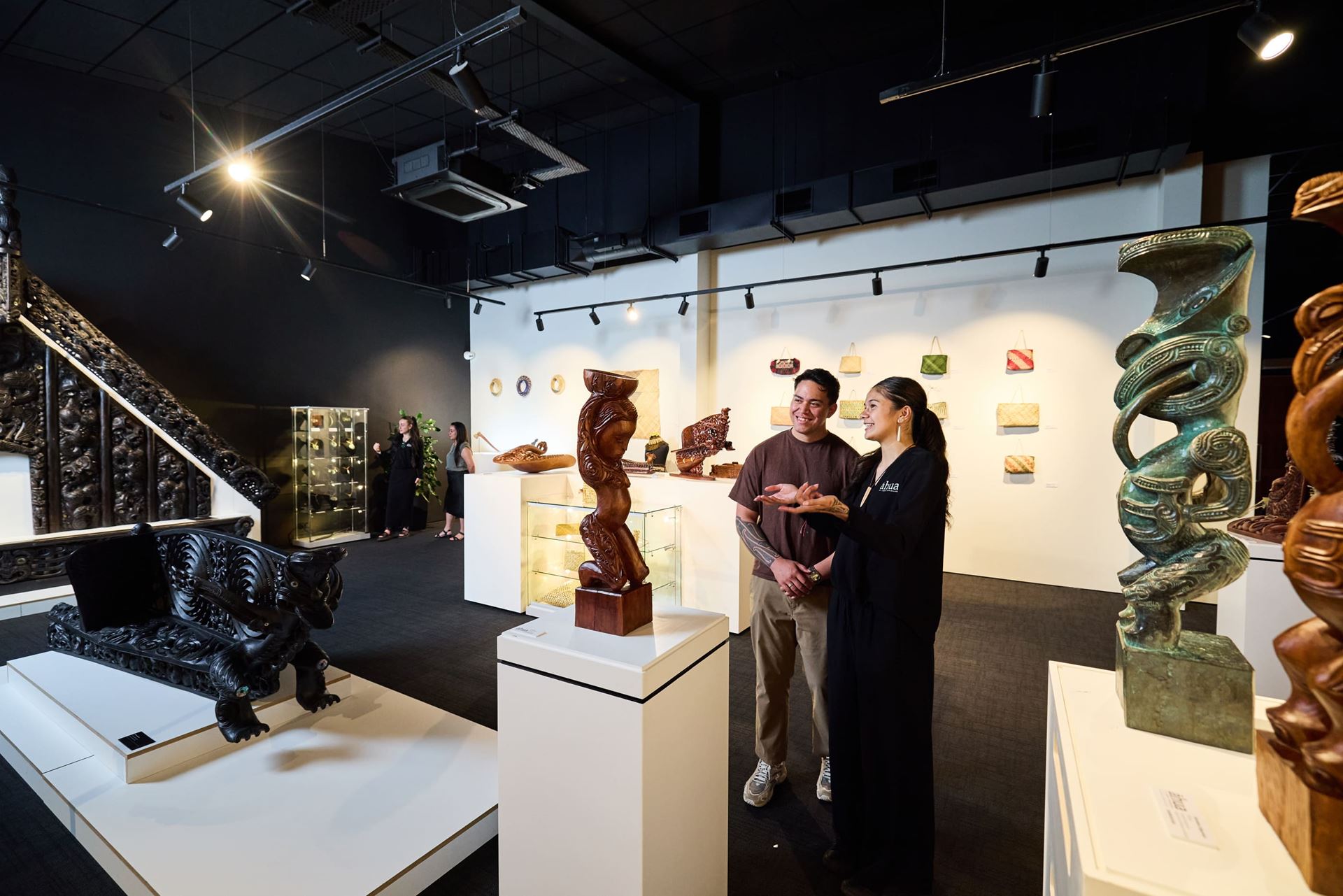
Āhua Gallery
Select Subcategory
Pāpaka (ed. 2/12) - 4080FD
Pāpaka (crab catching stick) originated in Hawaiki (the original homeland of Māori). Rēhua (the god of fish) handed a pāpaka to a rangatira (chief) before his journey to Aotearoa. This pāpaka is part of a limited edition of 12 bronze casts from an original wood carving by Kawana Waititi. The original will remain part of the New Zealand Māori Arts and Crafts Institute legacy collection.
$3,900.00

Kākahu (Contemporary) - 1630WK
The kākahu takes inspiration from traditional Māori cloaks. A kākahu is mantle of prestige and honour. This kākahu is made from mirowhiti miro (mop yarn) also incorporating materials that represent different types of kākahu including but not limited to kahu huruhuru (feathers) and tāniko.
Material: Cotton, Mop Yarn, Wool, Feathers
Measurements: 875mm x 775mm
$3,900.00
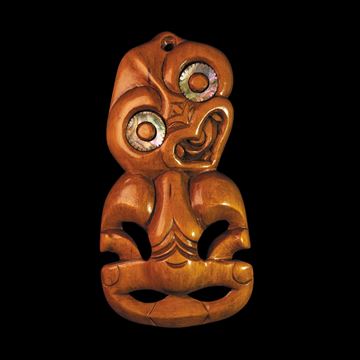
Hei Tiki - 6639CF
Hei tiki are the best known of all Māori adornments. Tiki are symbols of fertility that depict a new-born child. They are often family heirlooms bearing personal names and embodying their wearers lineage. As with most Māori personal adornments, hei tiki are often passed down generationally.
Material: Tōtara (Red Pine)
Measurements: 225mm x 115mm x 25mm
$3,900.00
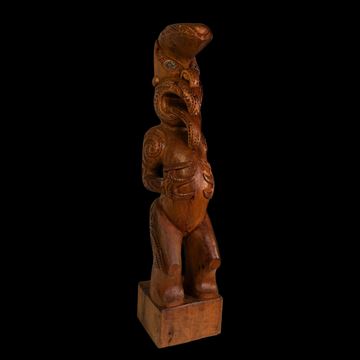
Tekoteko - 4813HG
The tekoteko is a stylised representation of the main progenitor of a tribe and is the most focal point of the whare whakairo (carved tribal meeting house). They can be found – on traditional meeting houses – either at the highest point at the front apex of the roof or at the front central post. They can also be found at the base of the poutokomanawa (the main central ridge support post) of the house.
Material: Tōtara
Measurements: 865mm x 210mm x 180mm
$4,200.00
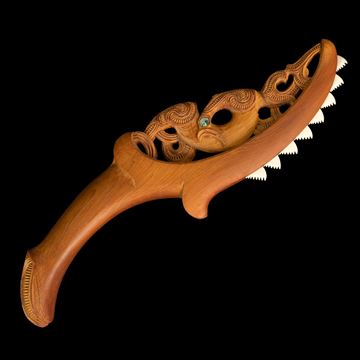
Māripi - CI2895
Māripi are a traditional meat cutting tool. They are fashioned with a wooden handle and sharks’ teeth carved from Kōiwi (beef bone) to create a serrated edge.
Material: Rātā, Kōiwi (Beef Bone) & Pāua (Abalone)
Measurements: 340mm x 100mm x 30mm
$4,200.00
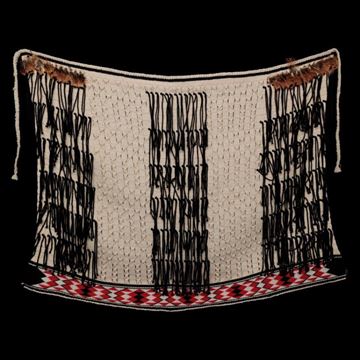
Kākahu (Contemporary) - 1731RA
The kākahu takes inspiration from traditional Māori cloaks. A kākahu is mantle of prestige and honour. This kākahu is made from mirowhiti miro (mop yarn) also incorporating materials that represent different types of kākahu including but not limited to kahu huruhuru (feathers) and tāniko.
Material: Cotton, Mop Yarn, Wool, Feathers
Measurements: 1016mm x 762mm
$4,400.00
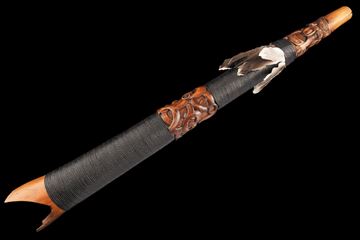
Pūkaea - 4798TJ
The pūkaea was the largest of the Māori trumpets, ranging in size from one metre (3.2ft) to over two meters (3.4ft) in length. They were made in two pieces and bound together with the roots of the kiekie (climber). Many pūkaea were carved and they often belonged to the chief of a tribe. They were typically used to call the tribe together.
Material: Matai
Measurements: 600mm x 70mm x 60mm
$5,900.00
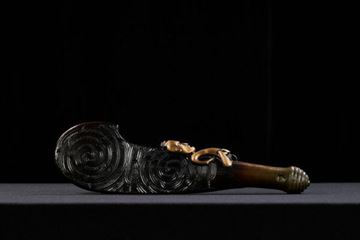
Wahaika - Black w Bronze (ed. 1/6) - 2487FD
The literal meaning of wahaika is: ‘waha’ (mouth); and, ‘ika’ (fish). It was specifically named because of the gap on the side of the weapon. Wahaika were used in close hand-to-hand combat to defect blows, and to strike the chest, head and wrist. Many wahaika have a small figure carved on their side called a pūkaiora which represented a tribal war God that would guard over the warrior during battle. The whiti or small head at the end of the handle was also a form of guardian. Wahaika are usually made from native hardwoods or whalebone.
$7,500.00
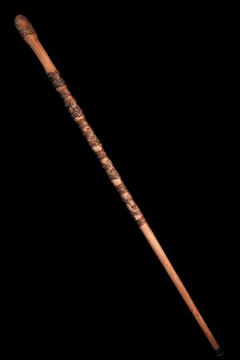
Tokotoko - 6853TH
Tokotoko are used when speaking on the marae – by esteemed orators – to indicate the direction of a speaker’s kōrero (speech). They often have the whakapapa (genealogy) of the orator carved into them and these can also be referenced by the orator during his address.
Material: Rātā
Measurements: 1050mm x 45mm x 45mm
$7,990.00
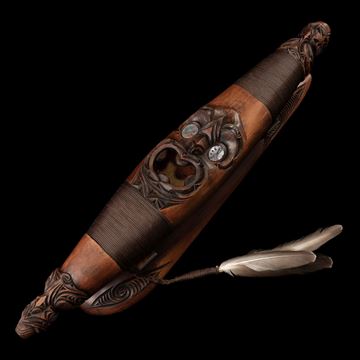
Pūtōrino (on Stand) - 4799KA
In Māori whakapapa (genealogy), all Māori flutes come to us from Hine Raukatauri, the daughter of Tānemahuta, the atua (spiritual entity) of the forest and birds. Hine Raukatauri is best known as the atua of flute music. She loved her flute so much that she chose to live inside it. She is now personified as the case moth that hangs from branches of trees in a long slender cocoon. This case moth cocoon is where the pūtōrino gets its shape from.
Material: Mataī (NZ Native)
Measurements: 400mm x 70mm x 50mm
$7,990.00
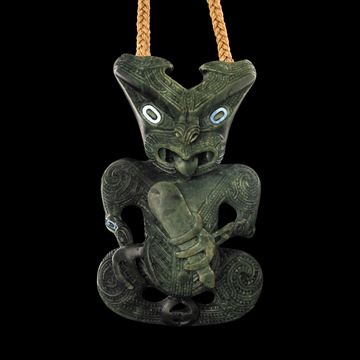
Hei Poupou - 6739PD
The interior walls of the whare whakairo (carved meeting house) are adorned with carvings called poupou. Each poupou in a meeting house connects to a common ancestor, after whom the house was named. Spaced evenly along the inside walls, each poupou supported a rafter panel which extended from the main central ridge, reinforcing the importance of whakapapa (genealogy) to the living generations.
Material: Pounamu (Kawakawa)
Measurements: 112mm x 68mm
$9,244.00
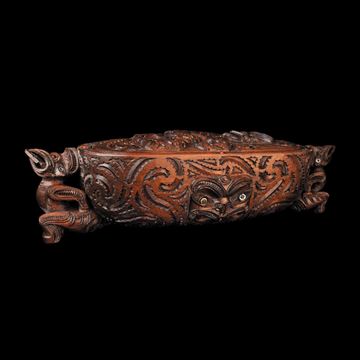
Wakahuia - 4783KA
Customarily wakahuia were vessels used for housing valuable feathers of the revered native huia bird. Following the extinction of the huia, wakahuia are now more commonly used to retain the treasured heirlooms of its owner such as hei tiki and other adornments. Wakahuia were originally designed to be suspended from the rafters of a dwelling and therefore had as much carving on the lower surface as the top. Wakahuia were highly prized and carefully treasured as they were passed between generations as heirlooms. They were often gifted between whānau, hapū and individuals to acknowledge relationships, friendships, and other significant social events.
Material: Tōtara
Measurements: 345mm x 110mm x 90mm
$9,500.00